

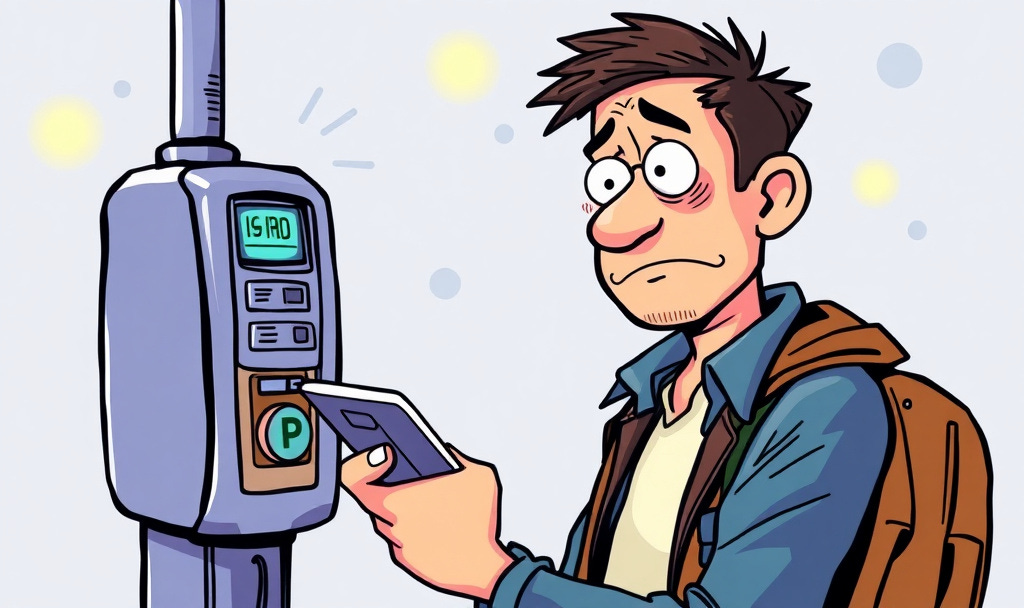
You need a phone to park your car in downtown Ypsilanti, Michigan. Yeah, Ypsi-f’ing-lanti, a town that can’t decide whether it wants to be a safe space for white rednecks or a sanctuary for black homeless people who so locust-swarm St. John the Baptist’s parking lot that its priest asks parishioners not to give them money, the ghost of Dorothy Day be hanged.
Ypsilanti’s best hope is that leftist gentrification by mindless professionals brings shloads of cash and an increased standard of living, even if it means turning the town over to eco-fascists and transgender nut jobs whose tolerance for different opinions stops just left of a Kamala-voting soccer mom.
Yeah, that junction of dysfunction now requires you to have a phone to park downtown. Hell, not just a phone . . . a smart one.
Theories in a secular world grow into dogmas and get enshrined as pseudo-gods. These gods then cascade injunctions back onto the earth. The injunctions include practices a person must observe if he wants to participate in society.
Technological Progress is the Zeus of our culture’s pantheon of gods.
No one knows exactly how it happened. One moment, William Blake was warning that Francis Bacon’s essays are for Satan’s kingdom. The next moment, your cell phone is buzzing against your genitals while you’re trying to get laid.
You can Kingsnorth against it, grind your teeth and writhe, but you will practice the religion of Tech Zeus, mother-f***’er, or you ain’t parking in Ypsilanti.
We’ve always had people who balk at the practices, either because they find them disagreeable at some level or just to be dicks. From heretics to preppers, from Old Believers to Luddites, from Charlie Daniels’ Long Haired Country Boy to St. Francis of Assisi, we’ve always had people who refuse to pick up what the secular gods are laying down.
Me? I refused to download the Ypsilanti parking app. Instead, I drove next door to Ann Arbor, where the love of free market money keeps its Stalinist impulses in check, and ate lunch. I don’t know if that makes me a rebel or a dick, but I’ve never gone back to downtown Ypsilanti.
Russell Kirk wouldn’t have cared if he needed a smartphone to park a car. He refused to drive those “mechanical Jacobins.” He died in 1993, before cell phones burst onto society like a crate of Boone’s Farm opened at a high school freshman girl sleepover, but I can assure you with more confidence than Conor McGregor entering the ‘gon to fight Ronda Rousey: he wouldn’t have carried one of those technological Jacobins.
Jac-o-bin n the most radical group of the French Revolution, implemented vigorous use of the guillotine to deal with the Russell Kirks of the world who refused to participate in worship services at the Church of Liberty, Equality, Fraternity.
Kirk didn’t have long hair, he didn’t get stoned in the morning and get drunk in the afternoon, and he didn’t lie around in the shade like his blue tick hound. . . heck, I don’t even think he owned a dog, much less a blue tick one . . . but he was very much like Charlie Daniels’ Long Haired Country Boy.
How do you know when a commodity has become more oppressive than Caligula on an off day?
It’s when you can’t find an alternative or decently do without it.
That’s when it has reached the level of “radical monopoly,” to borrow a term from the renegade Jesuit Ivan Illich, writing in Tools for Conviviality (1973). At that point:
* the commodity is producing obvious harmful side effects but people continue to use it (to practice the religion behind it) anyway;
* the commodity’s use is directly undercutting the commodity’s declared purpose (and becomes, in Illich’s glossary, “counterproductive”);
* the commodity is paralyzing independent action and, instead, demanding conformity from everyone.
I assume the cell phone’s position as a radical monopoly is more obvious than the painful sensation after getting kicked in the scrotal, so I won’t unpack it here.
Did I mention you can’t park your car in downtown Ypsilanti without a smartphone?
Illich pointed out that Western society is chock-full of radical monopolies. He especially railed at cars and the asphalt whores who service them, but I think he would’ve agreed that they pale next to the dizzying heights of radical monopoly attained by the cell phone today and must be resisted.
Whether he would’ve agreed that the cell phone’s radical monopoly is an existential threat along the lines of ten Godzillas invading Tokyo, I don’t know, but he would’ve urged resistance.
For starters, he would’ve told readers they needed to change their mindsets. Let’s face it, the cell phone feeds our appetite for acquisition like Sydney Sweeney feeds lust. We’re always grasping and the cell phone always offers more . . . and more and more and more . . . to grasp. If the Sydney Sweeneys of the world were as promiscuous as an app store, men would need a Batman utility belt of johnsons to satisfy them.
We need to stop, said Illich, and cultivate what his friend Wolfgang Sachs called “the virtue of enoughness.”
And then we need to invert the whole technology thing. We need to urge society to put man on top of the tool, not the tool on top of the man. If the man can’t or won’t use his phone to park in Ypsilanti, society should respect it.
But that, in turn, requires society to ask a primordial question: What is good for man? Once we figure that out, Illich said, we can adapt technology to foster the good for people and communities.
What’s good for us? That’s obviously a loaded question. You have the reprobate who thinks it would be good to clone Sydney Sweeney in the bajillions so he can pick one up at Dollar Tree. You have bastards out there who think it’s good for people to own nothing. You have the long-haired country boy who thinks it’s the highest good to be left the f’ alone so he can smoke and drink all day . . . and mendicants who agree but for different reasons.
But just because it’s highly unlikely society will ever be able to agree on what’s good for us, that doesn’t mean each of us can’t make that decision for ourselves. We need to opt for lifestyles of self-reliance and independence, and we need to vote for local and national leaders who allow us to pursue them. We can then use our freedom to support institutions and practices that don’t grab us by the back of our head and force us to kneel to Tech Zeus when we just want to grab a freakin’ burger and fries in downtown Ypsilanti.